
Arts and entertainment proof in brief
The Pyramids Echo: seven days at Pyramids Panorama, with 854 artist/staff service covers across the engagement plus separate crew, VIP, beverage and public-kiosk operations running around an international performance schedule.
ASEEL Egyptian Horse Festival: approximately 350 VIP guests inside a wider four-day equestrian festival, served through sculptural theatrical pass-around hospitality, choreographed circulation and a live non-alcoholic bar.
Russell Peters: backstage catering for the artist and a small inner-circle group of up to 12, where rider timing, exact preferences, controlled access and post-show readiness mattered more than headcount.
Netflix — Unknown: The Lost Pyramid at NMEC: reception catering for approximately 150 guests before and after the screening, with branded trays and a Netflix digital-bar animation integrated into the hospitality layer.
Hoopoe by ENID / ElNidaa: a 350-guest fashion and cultural-development programme at NMEC, where LOriental served as sponsor and caterer with arrival drinks and continuous pass-around service around the formal programme.


Start by separating the audiences
Large cultural and entertainment events often contain several hospitality briefs inside one programme. Artists may need structured meals before stage time. Crew can require earlier service. VIP guests may need a more refined reception layer. Ticket holders may simply need fast access to drinks and food through public points. Treating those audiences as one catering population usually creates the wrong service for at least one of them.
The Pyramids Echo is the clearest example. Artist and staff meals, crew snacks, a long-window drinks bar, VIP canapés and public kiosks all operated at the same venue, but each track had its own timing and purpose. The distinction between catering and public F&B remained explicit even though both belonged to the same festival operation.
Multi-day festivals are an operating system, not one long event
A festival can run for days while the performance schedule, audience mix and meal requirements keep changing. Consistency therefore matters as much as creativity. Service windows have to open on time, menu variation has to be planned for returning artists and staff, and equipment, replenishment and staffing have to remain dependable through long operating hours.
At The Pyramids Echo, the drinks operation could run from 9:00 a.m. to 11:00 p.m., with crew support, afternoon snacks, pre-show buffet service, VIP canapés, public kiosks and post-show needs layered around it. Across the week, the artist-and-staff schedule totalled 854 service covers. That number represents repeated service across the engagement, not 854 unique people.



Theatrical service works when it belongs inside the programme
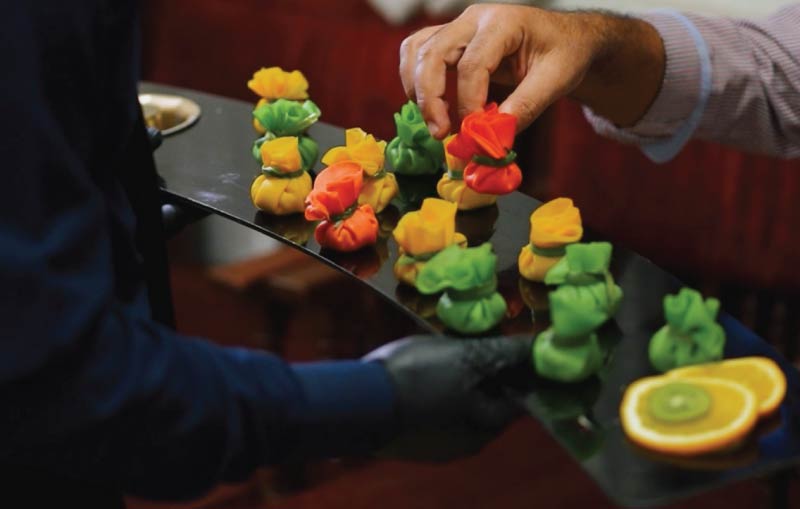
Some cultural events benefit from a more visible hospitality layer, but the event itself still has to justify it. ASEEL Egyptian Horse Festival did. VIP guests moved between judging, conversation, viewing Arabian horses and the closing auction, so asking them to leave the action for a fixed buffet would have broken the experience.
LOriental used sculptural pass-around hardware and choreographed circulation to let the hospitality move through the VIP areas. Approximately 350 VIP guests were within LOriental’s catering scope inside a wider festival of roughly 1,000 participants and guests. The theatrical qualification comes from the movement, custom hardware and guest interaction — not from the visual styling of the event alone.
Backstage hospitality is its own operating world
Artist hospitality can be tiny in headcount and still leave almost no room for error. Russell Peters’ Cairo engagement was for an inner-circle backstage group of up to 12 rather than the audience or full production crew. The challenge came from a touring rider that tied food and refreshments to arrival, stage timing, ingredient exclusions, water preferences, dressing-room provisioning and post-show availability.
That kind of brief rewards preparation and discretion. Once backstage access tightens, a missed refresh or wrong item is harder to correct casually. The catering has to be self-contained enough to support the artist schedule without becoming another production problem.
Screenings and cultural programmes need hospitality that can disappear
At a screening or performance, the central programme is not the meal. Hospitality may need to be active before the audience sits down, almost invisible while attention moves to the screen or stage, then ready again when the room returns to conversation.
For the screening of Netflix’s Unknown: The Lost Pyramid at NMEC, LOriental joined the event through the museum and supported approximately 150 guests with a welcome canapé reception and post-screening drinks. Branded trays and the familiar Netflix logo animation on the digital bar connected the hospitality to the media brand without overwhelming the museum setting or documentary.
Fashion and cultural-institutional events have a different rhythm again
The Hoopoe by ENID / ElNidaa fashion show at NMEC combined a runway presentation, handicrafts exhibition and formal institutional programme. LOriental’s role was sponsor and caterer, not producer of the fashion show or participant in ENID’s development programme.
For 350 guests, the service plan used arrival juice followed by continuous pass-around food with a 12-waiter team. The point was to keep hospitality mobile around speeches, runway movement and stakeholder interaction rather than pull the audience toward a fixed dining moment.
Public F&B is not the same as event catering
Some entertainment events need both. Public kiosks are designed around throughput, availability and transactions for ticket holders. Artist, crew or VIP catering is planned around a known service population, schedule and hospitality expectation. The two may share infrastructure, but they should not be described as one service.
The Pyramids Echo contained both models and is useful precisely because the scopes remained separate. That same discipline protects the rest of this page: backstage artist catering is not audience catering; VIP festival hospitality is not whole-festival catering; and a museum reception is not automatically event management.
Keep neighbouring event types clear
This page owns festivals, concerts, screenings, performances, fashion and cultural programmes where the artistic or entertainment context is central. Embassy-hosted cultural occasions remain under Embassy & Diplomatic Events when the official diplomatic purpose leads. A product reveal or creator activation built around a commercial brand belongs under Product Launches & Brand Events. Private parties belong under Private & Social Events.
A cultural event may use a standing canapé-and-beverage format, but that does not make it a generic Cocktail Reception. The Cocktail Receptions page explains the service format across many occasion types; this page remains centred on the arts, cultural or entertainment programme itself.


Arts, cultural and entertainment case studies
Across seven days at Pyramids Panorama, LOriental operated different hospitality tracks for artists and staff, crew, VIP guests and the ticketed public. The artist-and-staff schedule totalled 854 service covers while a 9 a.m.–11 p.m. drinks bar, public kiosks and other service windows continued around the festival programme.
Posh Management appointed LOriental for approximately 350 VIP guests inside a wider four-day equestrian festival. Sculptural pass-around hardware, choreographed movement and a live non-alcoholic bar allowed the hospitality to travel with guests through the programme rather than pull them toward a fixed dining point.
For the Cairo stop of the Act Your Age world tour, LOriental catered Russell Peters and a small inner-circle backstage group of up to 12. Rider timing, exact preferences, dressing-room provisioning, controlled access and food held for later service made precision more important than scale.
LOriental joined the NMEC screening through the museum, supporting approximately 150 guests with a welcome canapé reception and post-screening drinks. Netflix-branded trays and a digital-bar logo animation connected the service to the screening while the documentary and museum remained the focus.
For ENID’s first Hoopoe fashion show, LOriental served as sponsor and caterer for 350 guests. Arrival juice and continuous pass-around service supported a runway, handicrafts exhibition and formal development-sector programme without implying responsibility for producing the fashion show or ENID’s wider work.
Explore the full LOriental Case Studies library for more evidence across weddings, corporate events, conferences, diplomatic hospitality, cultural programmes, private celebrations and continuous B2B operations.

What has to work behind the scenes
Arts and entertainment hospitality is often governed by timing more than formality. Before the format is fixed, the operating plan needs the run of show, audience groups, artist or crew requirements, public-service windows, VIP separation, loading and setup access, back-of-house space, power, permitted service areas, equipment needs and the distance between production and the guest-facing programme.
The plan also needs clear scope boundaries. If LOriental is serving only a VIP area, backstage party or public kiosk, the team, quantities and logistics should be built for that exact population rather than the event’s total attendance. That accuracy is part of good operations as well as good communication.
Arts, cultural and entertainment catering questions
Planning an arts, cultural or entertainment event?
Tell us what is happening on stage, screen or across the programme, who needs to be served, how long the event runs and what the venue can support. We will shape the food, beverage and operating plan around the actual audience and event rhythm.