
Where Our Recipes Come From
Culinary research sits at the center of LOriental R&D. We study documented techniques, classic cookbooks and established culinary traditions, then test what belongs in our own menu and service environment.
Where a technique or recipe has a clearly documented, well-established source, we name it. Where a dish sits within a broader regional or culinary tradition rather than one specific origin, we describe it that way instead. That keeps the research honest without overstating any single connection — and it isn't intended to suggest that any named author, chef or restaurant has endorsed, trained, licensed, or partnered with LOriental.
| LOriental dish | Research reference | How it appears at LOriental |
|---|---|---|
| Beef Bourguignon | Julia Child's published braising method (Mastering the Art of French Cooking) | Used as the reference framework for browning, slow braising and sauce finishing; red wine is replaced with a tested red-grape-juice-and-vinegar alternative for our non-alcoholic program. |
| Chicken Marbella | The Silver Palate Cookbook (Sheila Lukins & Julee Rosso) | The prunes, olives and capers structure that defines the original recipe is preserved in our version. |
| Butter-Poached Lobster | Beurre monté, a butter-poaching technique used widely in modern fine dining and strongly associated with Thomas Keller | Used as the cooking medium for a gentle, precise poach; this is now a standard professional method rather than any one restaurant's proprietary process. |
| Beef Wellington | Gordon Ramsay's published Beef Wellington construction | LOriental follows the construction closely, including the crêpe moisture barrier, with Grison beef replacing prosciutto as the cured-meat component. |
| Smoked Salmon Pizza | Wolfgang Puck's smoked salmon pizza concept | Used as the culinary reference for a baked base finished after baking with a creamy component, smoked salmon, herbs and a fresh garnish; tested and approved through LOriental's own R&D process before entering the menu. |
| Duck with Orange Sauce | Classical French canard à l'orange tradition | Follows the classic sauce structure and citrus-driven finish associated with the French preparation. |
Why we describe the research this way
"Internationally inspired" says very little about how a dish was actually developed. A more useful description tells you that the Bourguignon uses Julia Child's braising method, that the Wellington follows Gordon Ramsay's published construction, or that the lobster is cooked using beurre monté. Those details show what the R&D team actually studied and carried into the recipe. This page exists to document our own research process — it is not a marketing page, none of these dishes are sold or advertised under a chef's name, and nothing here is built to be found by searching for the chef instead of the dish.
The reference still has to work in LOriental's environment: non-alcoholic service, large events, live stations, buffets, passarounds and synchronized dinners. Some methods transfer directly; others need careful adaptation before they earn a place in the Master Recipe Database.
A note on sources
Named cookbooks, authors and documented techniques are referenced here to describe how LOriental's recipes were researched and developed. Unless explicitly stated otherwise, none of these references imply endorsement, training, licensing, partnership or affiliation with any person, restaurant or brand.
How Ideas Become LOriental Dishes
A snapshot of the references, tests, service challenges and real-world event experience that shape how we develop dishes and live stations.
| Example | How it entered R&D | What changed or was learned |
|---|---|---|
| Beef Bourguignon | Julia Child reference + non-alcoholic adaptation | The classic braising approach was retained while LOriental separately developed a grape-juice-and-vinegar solution to replace the role of red wine. |
| Beef Wellington | Gordon Ramsay reference + canapé adaptation | The crêpe moisture barrier was retained, while the whole Wellington was reconstructed as individual bite-sized portions. |
| Butter-Poached Lobster | Classical technique research | Direct butter poaching proved greasy and difficult to control; beurre monté produced better temperature stability, texture and coating. |
| Chicken Marbella | International recipe research + event suitability | The prune, olive and caper-based dish offered a less conventional chicken option that also held and reheated effectively for event service. |
| Asian Cucumber Salad | Social-media trend research | An Instagram and TikTok trend was researched and tested, with moisture control and preparation refined before it entered the event menu. |
| Mongolian Fire Grill | First-hand international restaurant exposure | Kitchen trials established the protein thicknesses, vegetable cuts and preparation stages needed for all ingredients to finish together on the grill. |
| Shawarma Station | Personal Gulf food experience | A Lebanese-Gulf shawarma profile familiar from the UAE was recreated for the Egyptian market and later developed from mini rolls into a live station. |
| Live Paella | Culinary concept + equipment problem | The required scale could not be sourced locally, so LOriental commissioned its own approximately one-metre paellera. |
| Om Ali Oasis | Egyptian classic + experiential service | A familiar buffet dessert became a live station through individual torching and a customizable topping system. |
| Vine Leaf Sushi | Egyptian staple + sushi service language | Vine leaves were reworked through new fillings, live rolling, mint-yogurt accompaniment and caviar-style pearls into a distinct station format. |
| Risotto Rêverie | Service-format test → permanent rule | Mobile Parmesan-wheel trolley service for synchronized seated dining compromised texture; plated service and stationary Parmesan-wheel service were retained. |
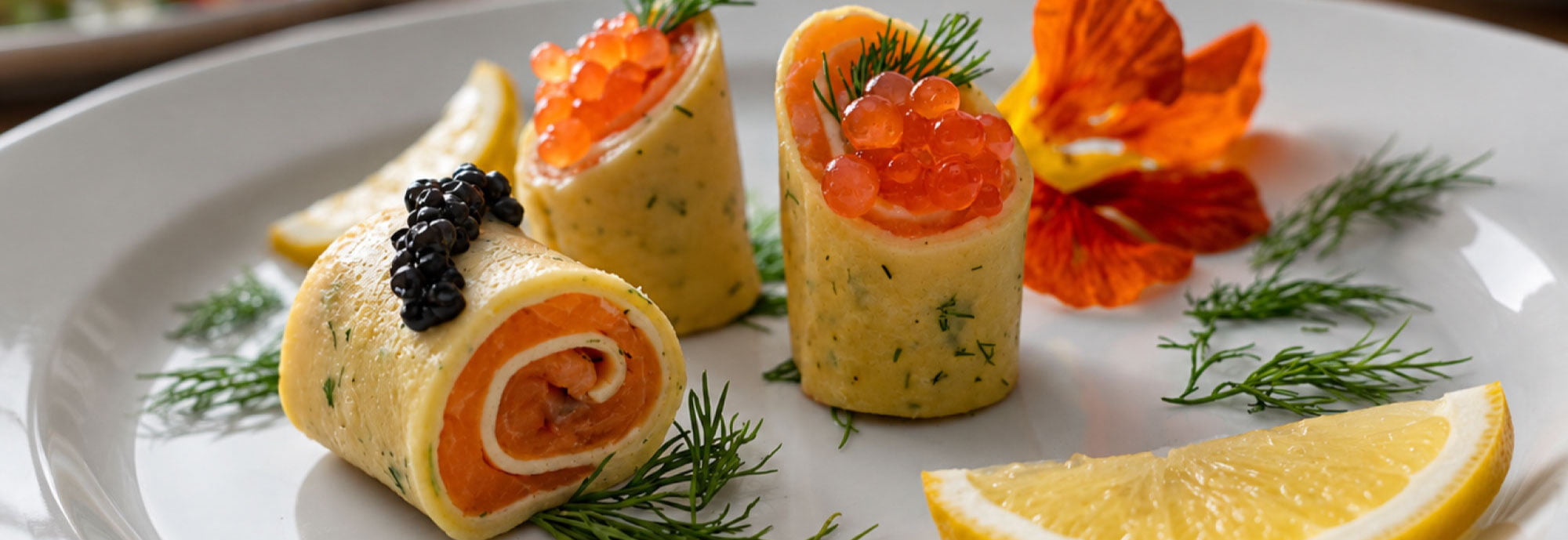
| Smoked Salmon Pizza | Wolfgang Puck reference + format adaptation | The smoked-salmon pizza concept was retained and reformatted into individual canapé-sized pizzas for event service. |
Culinary R&D Journal
These are first-hand notes from the research, testing and live-event experience behind selected LOriental dishes and stations. Some started with a cookbook or chef technique, others with something we experienced while travelling, a trend we saw guests responding to, or a problem that only became obvious once we tried to serve the dish at an event.
Beef Bourguignon, without the wine
The Wellington's moisture barrier
From Wolfgang Puck's kitchen to an Egyptian event
Beef Bourguignon, without the wine
We originally went looking for a slow-cooked beef dish that could sit comfortably beside the familiar Egyptian idea of kebab halla, but feel completely different on the menu. Beef Bourguignon was an obvious direction, and Julia Child's published method became one of the references we worked from.
The problem was the wine. We already used grape juice occasionally as a non-alcoholic alternative in cooking, but in the Bourguignon it made the sauce too sweet. Eventually we stopped working on the dish itself and treated the wine replacement as a separate R&D exercise. We tested grape juice with regular white vinegar, rice vinegar, rice-wine vinegar and apple vinegar, changing the ratios each time.
The combination we finally approved uses grape juice and regular white vinegar in a ratio we keep proprietary. Once we had that balance of sweetness and acidity right, we went back to the Bourguignon and built the final recipe around it.
From Wolfgang Puck's kitchen to an Egyptian event
Smoked salmon has always been one of those ingredients that immediately reads as luxury to many Egyptian guests, so we are constantly looking for ways to use it beyond the familiar crostini, crêpes and smoked-salmon mousse.
Wolfgang Puck's smoked salmon pizza caught our attention because it put the ingredient on a completely different base without losing what made the original dish appealing. The idea made immediate sense for LOriental, but a full pizza obviously did not fit the way we served finger food.
So we kept very close to the concept and changed the format. Instead of one large pizza, we developed individual mini smoked salmon pizzas that could be served as canapés. It was a relatively simple piece of R&D compared with some of our other dishes, but it is a good example of how we work: find an idea worth learning from, understand what makes it work, then adapt the format to the realities of event catering.
Chicken Marbella
When we were building our earlier menu collections, we wanted several chicken dishes, but we did not want the selection to become a predictable rotation of fried, roasted and oven-baked chicken. There was another practical consideration as well: event food has to survive holding, transportation and reheating without losing the reason you chose the dish in the first place.
During that research we came across Chicken Marbella. The combination of prunes, olives and capers immediately felt different from the more familiar chicken dishes we were seeing around us. It had a Mediterranean character, plenty of flavour and a sauce-based preparation that made sense for event service.
It also fitted naturally into the internationally influenced menus we were developing. We tested it, liked both the flavour and the way it performed operationally, and kept it. Sometimes R&D means inventing something new; sometimes it means finding an established dish that solves exactly the problem you were trying to solve.
Vine Leaf Sushi
Vine leaves are such a staple of Egyptian events that avoiding them altogether would make little sense. Serving them exactly as everyone else does made even less sense to us.
Our first interpretation came during the finger-food years. We formed the vine leaves into small domes, garnished them with pomegranate seeds and called them Vine Leaf Bites. They looked elegant, were immediately recognizable without looking conventional, and became one of our most requested items.
When we later moved into live stations, we wanted to take the idea much further. The R&D Panel started exploring a fusion between Egyptian vine leaves and the theatre of sushi: live rolling, multiple fillings, colour and a chef preparing everything in front of the guest. We developed versions with oriental rice, caramelized beef, chicken liver and caramelized shrimp rather than relying only on the traditional herb-rice filling.
Even the accompaniments became part of the exercise. Mint yogurt was adjusted in colour and texture to play the visual role of wasabi. We then researched spherification-style techniques and made our own pomegranate and cucumber pearls using agar agar and cold oil.
The station looked familiar and completely unfamiliar at the same time. Guests understood immediately that they were eating vine leaves, but the experience around them had changed entirely. It became one of our strongest live-station launches.
Mongolian Fire Grill
The Mongolian Grill had been sitting on our R&D bucket list for years. Sherif had experienced the format several times in Canada and the United States, and much earlier with his family in Qatar. What stayed with him was the freedom of it: walk through an open display, fill a bowl with whatever combination of proteins, vegetables and noodles you want, then watch the entire thing cooked in front of you.
When we finally built the LOriental version, we gave the display the same attention as the food. Raw ingredients sat over ice, LED lighting and theatrical elements were incorporated into the station, and the whole setup was designed to look as impressive before cooking started as it did once the grill was working.
The difficult part turned out to be prep. Chicken, beef, shrimp, vegetables and noodles all have different cooking times, yet the chef needs everything in one guest's bowl to finish almost simultaneously. We tested different protein thicknesses, vegetable cuts and levels of pre-cooking for the noodles and rice. The proteins also needed to be almost frozen before slicing so they could be cut extremely thin and cook quickly without becoming chewy.
We staged the complete station inside our kitchen and ran it repeatedly. After a few attempts, the proportions and preparation finally lined up. What looks spontaneous in front of the guest is actually the result of a lot of very precise work before the event begins.
Shawarma Across Lebanon, the Gulf and Egypt
Shawarma came into our menu through memory as much as research. Sherif grew up in the UAE and spent much of his life in the Gulf, so the chicken shawarma he knew was the Lebanese-Gulf style associated with places such as Zahret Lebanon and Tarboush, two names closely tied to the Abu Dhabi shawarma experience he grew up with.
When he later moved to Egypt, the shawarma he encountered was different. The bread was often different, the marinade tasted different and the overall construction reflected the Syrian-style shawarma that had become common locally. What he missed was the combination he remembered from the Gulf: Lebanese pita, chicken shawarma, toum, cucumber pickles and French fries.
That became the brief for our version. We were not trying to invent shawarma; we were trying to recreate a very particular taste memory and bring that Lebanese-Gulf interpretation into LOriental's menu in Egypt.
It started as miniature shawarma rolls during our finger-food period. As the live-station side of the business grew, the same idea evolved into a full Shawarma Station, where carving, assembly and service happen in front of the guest.
The Wellington's moisture barrier
Beef Wellington goes back to LOriental's early finger-food days. We were looking for a rich beef canapé, something more interesting than simply putting a piece of steak on bread, and Gordon Ramsay's Beef Wellington was one of the first constructions we tested.
We initially followed the technique closely, including the crêpe wrapped around the beef before the pastry. It worked. Then we deliberately tried it without the crêpe to see how much difference that extra layer was really making. The pastry was noticeably soggier, so the crêpe stayed.
The bigger adaptation was size. A whole Wellington made no sense for the kind of finger-food service we were building, so we cut the beef into individual portions and constructed each one as a miniature Wellington. That became the basis of our Beef Wellington bites: the same moisture-control principle, translated into something that can actually move through an event as a canapé.
Beurre monté and how it changes lobster
When we decided to introduce poached lobster as a luxury add-on, butter seemed like the obvious place to start. Our first tests were exactly that: lobster poached directly in melted butter.
The result was disappointing. The lobster could feel slightly sinewy and greasy, the butter tended to slide away rather than coat it, and ordinary melted butter broke down quickly enough to make controlling the cooking temperature more difficult.
We then tested beurre monté, a stable butter emulsion, and the difference was immediate. It stayed together for much longer, gave the chef far better control during poaching and left the lobster with a smooth, glossy coating rather than an oily one. The texture felt almost silky.
That was enough to settle the method. For us, beurre monté was not an elaborate technique added for the sake of sounding technical. It solved three practical problems at once: temperature control, texture and finish.
Risotto Rêverie
Our risotto problem was never that risotto could not work at an event. It was a very specific service format that failed.
For a seated event of around 100 guests, the client wanted risotto but did not want it to arrive as an ordinary plated course. She wanted an experience. We decided to finish and serve it from Parmesan wheels mounted on four mobile food trolleys moving through the room.
That created the problem. To have all four trolleys operating together, we needed enough risotto to load four Parmesan wheels at roughly the same time, with around 20 to 30 portions going into each. The oversized batches compromised the texture we wanted.
That event changed the rule. We still serve risotto as a plated course, and we still serve it from a Parmesan wheel at a stationary live station where batches can be controlled. What we stopped doing was combining Parmesan-wheel finishing, mobile trolleys and synchronized seated service. It was a good idea visually. Operationally, it asked too much of the risotto.
Viral Asian Cucumber Salad
This one started on TikTok and Instagram. For a period, the accordion-style cucumber was everywhere: a whole cucumber cut diagonally from opposing sides so that it opens into that distinctive spring-like shape.
We do a lot of weddings, and many of the brides, grooms and guests we serve are in their twenties. They are the generation seeing food trends online before those trends appear on conventional catering menus, so ignoring social media as a source of culinary ideas would make no sense.
We looked through several versions of the salad and chose one of the best-reviewed approaches to test. The preparation mattered as much as the dramatic cut, particularly salting the cucumber to draw out excess moisture before adding the dressing and final drizzle.
It was a smash hit. Guests already recognized the visual language of the dish before tasting it, which gave the item an immediate connection to the culture they were seeing online. The trend brought them to it; the flavour was what allowed it to stay on the menu.
Live Paella
Our first Live Paella station came from a simple ambition: if we were going to introduce something that was still unusual in Egyptian event catering, we wanted guests to see it from across the room.
The opportunity was an event for YouTube at Prince Naguib's Dahab Palace, with around 150 guests. We wanted to cook the paella live in one oversized vessel, both to handle the quantity and to create the visual impact we had in mind. The problem was that we could not find a paella pan locally at anything close to the scale we wanted.
So we went to a local blacksmith.
We explained that a paellera is not simply an enormous frying pan, worked through the shape and proportions with him and commissioned a pan approximately one metre across to our specifications. Once it was finished, we tested it before the event to make sure it actually cooked the way we needed it to.
It did. The pan became part cooking equipment and part scenery, and that first event established the format we still associate with our Live Paella experience.
Om Ali Oasis
Om Ali presents the same problem for desserts that vine leaves present for savoury food: almost everyone wants it, and almost every Egyptian buffet already has it. We wanted to keep the dessert people knew while changing what actually happened when they ordered it.
The answer became Om Ali Oasis, built as a live dessert station rather than another tray on the buffet. Guests receive a portion from the large serving dish, then the chef caramelizes the surface directly on the individual plate using a blowtorch.
From there, the guest takes over. We kept the familiar mixed nuts and raisins but added a much wider topping selection: fresh and dried fruits, broken honeycomb, toasted coconut, chocolate drizzle, caramel and other additions that would not normally appear with Om Ali.
Nothing about the exercise was intended to disguise the original dessert. It was still unmistakably Om Ali. We simply gave guests something to watch, something to choose and a reason for a very familiar Egyptian dessert to feel new again.