
Restaurant cooking and event catering ask very different things of a dish. In a restaurant, the kitchen usually controls when a plate leaves the pass, how far it travels and how quickly it reaches the table. An event may involve a temporary kitchen, restricted venue access, long service routes, outdoor conditions and hundreds of guests who need to be served within the same window.
That changes how we develop food. At LOriental, a dish is considered not only for how it tastes in the kitchen, but for how it will be cooked, held, transported, finished and served at the actual event. Sometimes that means changing the preparation. Sometimes it changes the portion size, equipment or service format. Occasionally it means deciding that a particular idea simply should not be served in a particular way.
Our Culinary R&D process is designed around that reality.
What Changes When Food Leaves the Kitchen
Temperature
Temperature is not simply a food-safety question. It can change the dish itself.
We look at where the food will be cooked, the distance to the guest, how much time can pass before service and whether the final stage should happen in the kitchen or closer to the table.
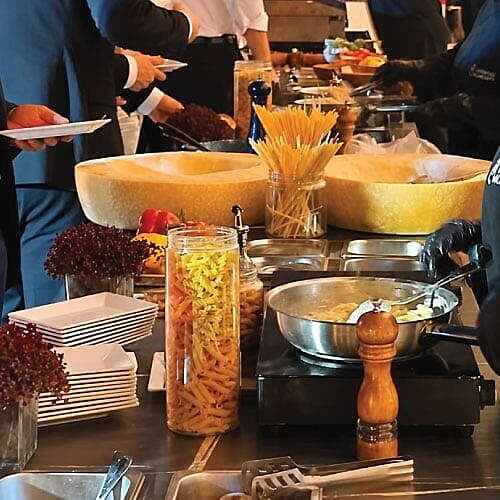
Some dishes tolerate holding extremely well. Others need the final cooking or finishing step moved closer to the guest. A live grill, carving station, Parmesan-wheel finish or tableside torch is sometimes theatrical, but it can also solve a culinary problem by shortening the time between the final stage of cooking and eating.
Texture
Texture often has a shorter service life than flavour.
A sauce may hold beautifully while a fried coating softens. A laminated pastry can lose its crispness once assembled. Risotto continues absorbing liquid after it leaves the pan. A glazed component may behave differently after twenty minutes of holding than it did during a tasting.
That is why we consider the complete service journey rather than only the recipe.
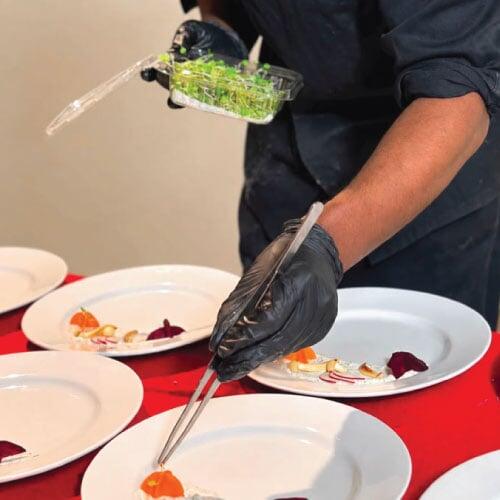
Our Mille-Feuille Royale, for example, benefits from final assembly close to service because that helps protect the pastry's texture. Fried, crisp and delicate components are approached in the same way: the question is not simply whether we can prepare them, but how close to the guest the final step needs to happen.
Batch Size Is Part of the Recipe
Scaling a recipe is not always multiplication. A sauce that works for ten portions may work perfectly at fifty. Risotto does not necessarily behave that way. Neither do ingredients that need to hit a hot grill simultaneously and finish at different natural cooking times.
Our experience with Risotto Rêverie made this particularly clear. For a seated event of around 100 guests, we attempted an experiential service using four mobile Parmesan-wheel trolleys. To operate all four at roughly the same time, each wheel needed a substantial quantity of risotto. The resulting batch sizes compromised the texture. The lesson was not that risotto cannot be served at events. We still serve it as a conventional plated course, and we can finish it from a Parmesan wheel at a stationary live station where batch size is controlled.
What we stopped doing was combining multiple mobile Parmesan wheels with synchronized seated service. That distinction matters. The service format failed, not the dish.
Read the Risotto Rêverie R&D story →
Preparation Determines What Happens Live
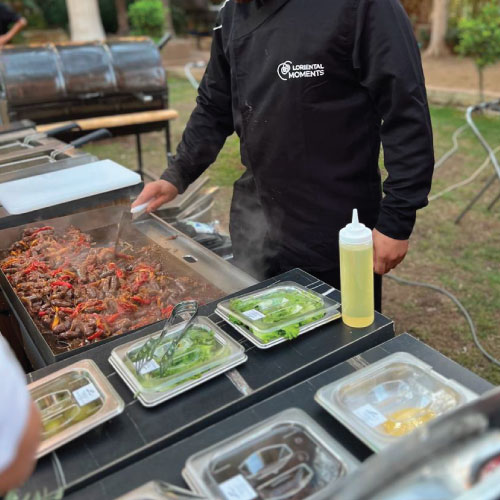
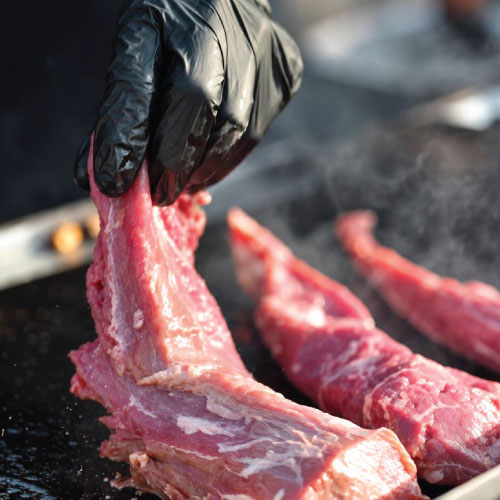
Some of the most important work at a live station happens hours before the guest ever sees it. Our Mongolian Fire Grill is a good example. Guests choose their own combination of proteins, vegetables and noodles, and everything then needs to cook together quickly on the same grill.
That only works if the preparation has already been engineered around cooking time. During development, we tested different protein thicknesses, vegetable cuts and preparation stages for the noodles and rice. The proteins needed to be sliced extremely thin, often while almost frozen, so they would cook quickly without becoming tough. Vegetables needed to remain crisp while the proteins cooked through.
We staged the full station in the kitchen and tested combinations repeatedly before using it at an event. What appears spontaneous to the guest is built on very controlled preparation.
Explore Live Culinary Stations →
Finishing Closer to the Guest
Moving a cooking step into the room is sometimes about theatre. Often, it also improves the food. Across our menus, final steps can include:
- carving a whole roast
- wok tossing
- finishing risotto
- tossing pasta with its sauce
- slicing sushi
- brûlée and live torching
- final dessert assembly
- grilling proteins
- carving shawarma
The important question is whether moving that step closer to the guest actually improves the dish or merely adds activity.
With Om Ali Oasis, for example, live torching changes both the experience and the final surface of the dessert. With a whole tenderloin, carving close to service allows better control over portions and doneness. With risotto, the live element only works when the batch itself remains under control.
We do not treat live cooking as decoration. The service method still has to make culinary sense.
Guest Flow Is a Culinary Constraint Too
A beautiful station that creates a queue is not a successful one. We design live formats around throughput, guest interaction time, staffing, service points and ingredient replenishment.
What works for 60 guests may not work for 500 without parallel cooking points, partial advance prep or multiple stations. Food and guest flow have to be designed together.
The Venue Changes the Menu
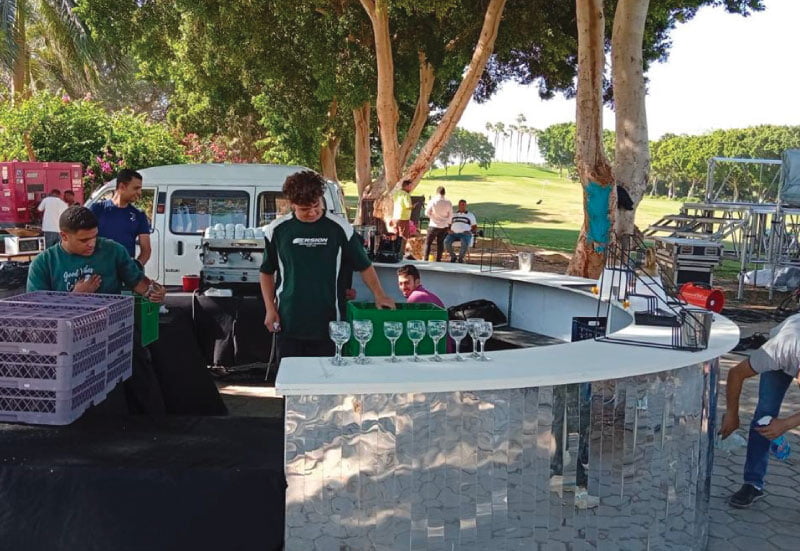
The same menu does not perform identically in every venue, we consider these operational issues:
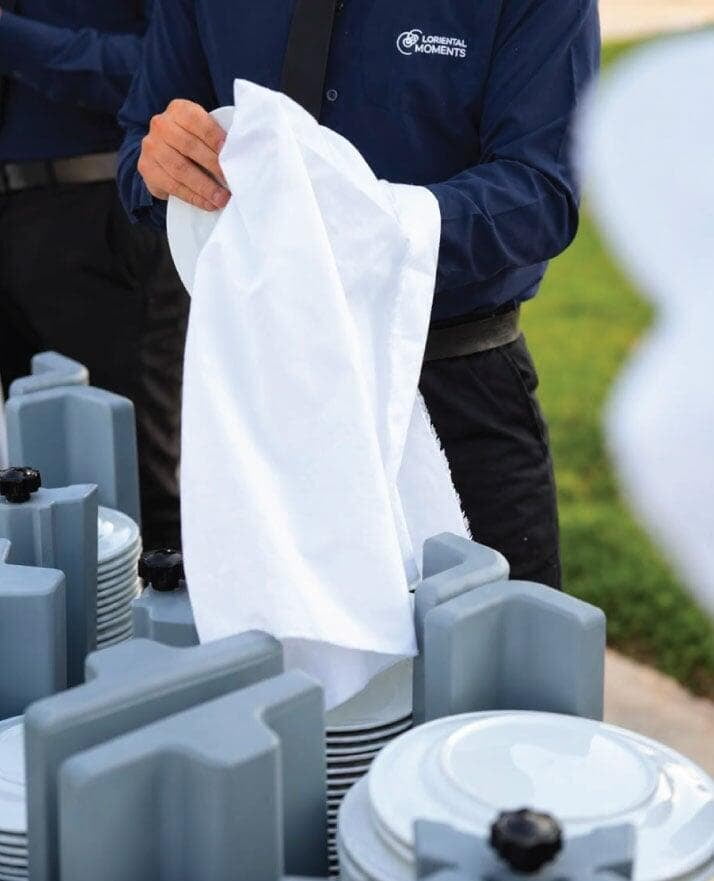
Kitchen distance
Kitchen distance
How far does food travel from production or finishing to the guest?
Back-of-house space
Can the venue support the equipment, holding and preparation the menu requires?
Access
Can ingredients, equipment and service staff reach the production area easily?
Power
What can realistically be operated on site?
Fire restrictions
Can open flame, charcoal or torch finishing be used?
Outdoor conditions
Wind, heat and humidity can affect both equipment and food.
Service routes
A short route from kitchen to ballroom allows different menu decisions from a historic or outdoor venue with a long walk between production and guests.
This is why venue planning and menu planning cannot be treated as separate conversations.
Not Every Dish Should Be Served Every Way
One of the most useful results of culinary R&D is learning what not to do.
A dish may work beautifully plated but poorly as a pass-around. Another may be ideal for a live station but lose too much quality when held on a buffet. Some preparations can be scaled almost indefinitely; others require several controlled batches operating in parallel.
We would rather change the service format than compromise the food simply because a particular presentation looked attractive on paper.
That principle influences everything from open buffet and seated dining to live culinary stations and the dishes recorded in our Signature Dishes Library.
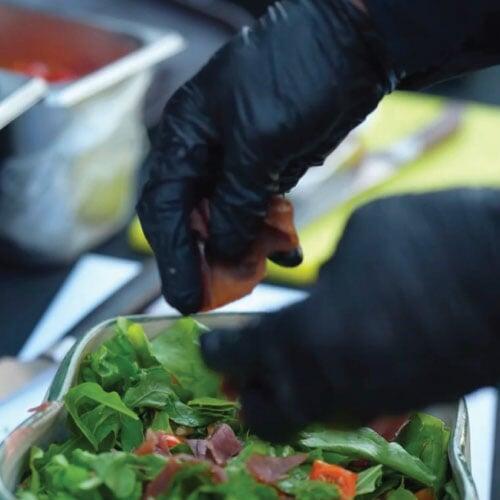
Plan the Food Around the Event
Plan the Food Around the Event
The menu, venue, guest count and service style all affect one another. We build the food around those conditions from the beginning rather than trying to solve them once production has already started.